
News
Croatia can install 5G infrastructure on wooden telecommunication poles
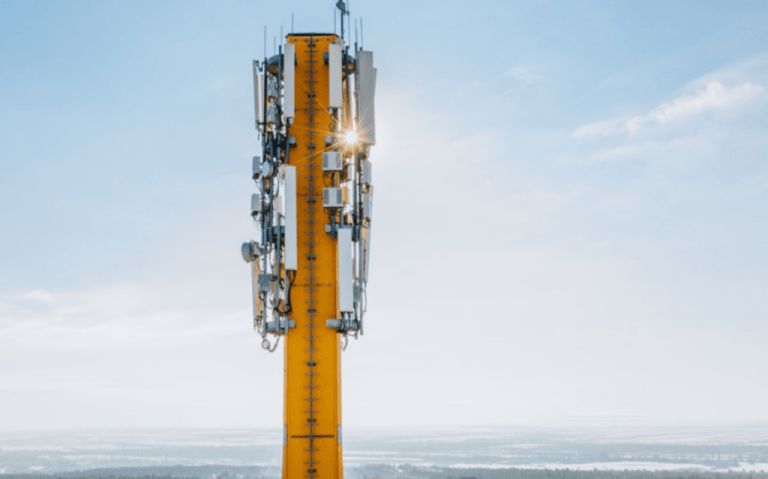
In the next few years, huge investments in broadband and 5G infrastructure are expected, among which telecommunication poles will be the most visible.
An environmentally friendly solution certainly includes telecommunication poles of wooden structure, which are also a more aesthetically appealing alternative, a characteristic that should not be neglected considering the natural and cultural beauty that represents one of the main attractions of Croatia as a tourist destination.
Ecopol wooden-structure poles, developed by the Finnish company Ecotelligent, are built from processed wooden pole elements in order to ensure the necessary elasticity and to support all future static requirements brought by modern communication networks (engineered wood), thus emitting half as much CO2 as traditional steel poles. The material they are made from can be reused, which aligns with the principles of the circular economy, towards which the European Union strives. Croatia is just entering a large cycle of investments in 5G infrastructure, so it could use these wooden-structure telecommunication poles in order to secure the fastest network in all areas with environmentally friendly infrastructure. Markoja d.o.o. is the distributor of Ecopol in Croatia.
The motto of the company Markoja d.o.o. is the concept of 5E in every project we work on, which means that in addition to the already traditional energy, ecology and economy, we also ensure aesthetics and ethics. Ecopol telecommunication poles certainly fit into our business logic, which is guided by sustainable and responsible business principles, because they produce significantly less CO2 than traditional poles, are aesthetically more acceptable, and given that they are made from recycled timber, they can also be called an ethical product – explained Boris Markoja, a member of the management of Markoja d.o.o.
These poles could therefore prove to be a very interesting solution for protected areas such as national parks, rural areas or tourist centers, i.e., in all locations where they fit more naturally into the environment than gigantic steel units. The first question that arises when we think about wooden-structure poles is fire resistance, as well as the lifespan of such installations. These telecommunication poles last at least 30 years and also have fire protection.
Ecopol poles are made of processed wooden pole elements (engineered wood), and in the event of a fire, the material behaves in such a way that the charred surface insulates the rest of the wood, thereby slowing down the burning process. In Eurocode, there is a clause that requires wooden structural elements to be designed and constructed in such a way that in the event of a fire outbreak, it is possible to estimate the load-bearing resistance of the structure during a specific time period. To meet this requirement, wooden products have their own certified nominal charring rate of 0.76 mm/minute on KertoQ panels. Fire resistance can be increased, for example, by increasing the thickness of wooden panels – as explained by Ecotelligent.
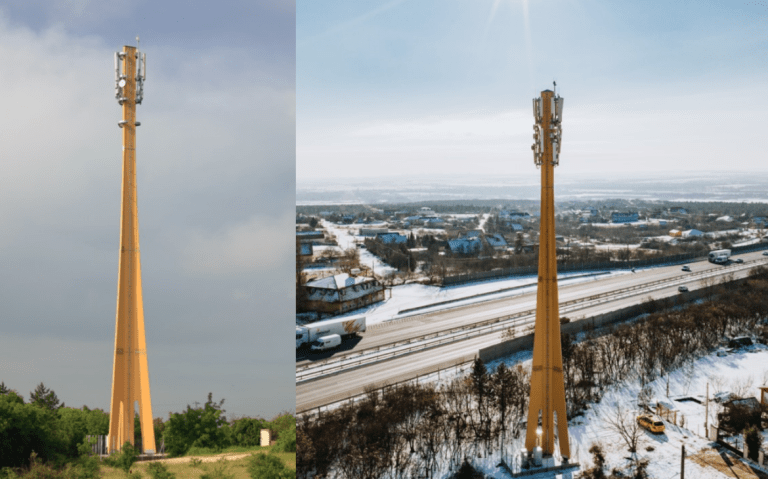
The Ecopol wooden pole is a self-supporting conical pole that serves as a support for mobile antennas and other devices necessary to ensure faster and higher-quality connectivity. It has a large load-bearing capacity, so it can support the same amount of equipment and devices as a steel pole or concrete structures. Required cables can be installed inside the pole itself, which provides protection against theft and fire. It is installed on a reinforced concrete block, the surface of which depends on the height of the pole, and it can reach up to 40 meters depending on the type of soil on which it is placed and the load-bearing capacity of the pole.
A large number of new telecommunication poles is expected during the transition from 4G to 5G technology, and this includes the construction of 60 to 80 thousand new locations over the next five years in Europe. If only one percent of all new supporting poles were built in wood, CO2 emissions would be reduced by 17,000 tons – according to Ecotelligent.
Prototypes of wooden poles for 4G technology are already being tested in Hungary, and the Finnish company hopes that larger production lines will accelerate production, which would ultimately lead to cost reduction and increased product competitiveness. The concept has been presented to telecom operators in Germany, Italy and the United Kingdom, and the initial reactions have been positive. Alongside the development of large towers, the Finnish company Ecotelligent is also developing smaller units, which during the transition to 5G technology will be designed for urban environments and should be installed in parks, streets and on residential building rooftops. Ecotelligent also presented its solutions at the TowerXchange Meetup Europe conference, which virtually gathered the entire industry. The theme of the conference was precisely investments in new infrastructure and the investments expected across Europe in the field of 5G infrastructure.
We're proud of our...

150 +
clients
60 +
employees
30
years of doing business